
Last checked: September 2026
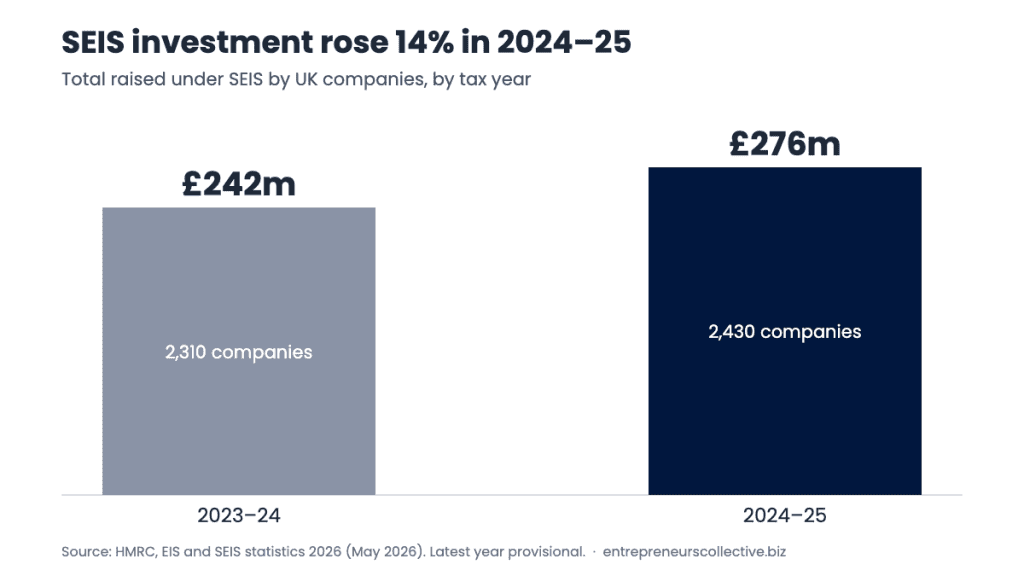
UK startups raised £276 million under SEIS in the 2024–25 tax year, up 14% on the year before. That is 2,430 companies, according to HMRC’s latest figures, published in May 2026. More founders are using the scheme, more angels are claiming the relief, and most of the money comes from a small number of larger cheques.
Here is what the numbers show, what the wider first-round market looks like in 2026, how much is going to AI, and what it all means if you are raising a SEIS round now.
SEIS statistics 2026: key figures
- £276m raised under SEIS in 2024–25, up 14% (HMRC)
- 2,430 companies, around 1,775 of them raising under SEIS for the first time (HMRC)
- About £114,000 raised per company on average, against a £250,000 limit (our calculation from HMRC figures)
- 56% of SEIS investors put in £10,000 or less, but cheques over £25,000 made up 66% of the money (HMRC)
- 58.6% of UK first-time investment by value went to AI companies in the first half of 2026 (Beauhurst)
How much was raised under SEIS in 2024–25?
£276 million, by 2,430 companies, up 14% on 2023–24.
| 2023–24 | 2024–25 | Change | |
|---|---|---|---|
| Companies raising under SEIS | 2,310 | 2,430 | +5% |
| Total raised | £242m | £276m | +14% |
| Investors claiming income tax relief | 10,290 | 11,200 | +9% |
| First-time SEIS companies | – | around 1,775 | – |
| Raised by first-time companies | – | £229m | – |
Source: HMRC, May 2026. The +5% and +9% are our calculations from HMRC’s figures. HMRC treats the latest years as provisional, because companies have up to three years to file their compliance statements, so the 2024–25 numbers are likely to rise when they are revised.
How much does the average SEIS company raise?
About £114,000, well under the £250,000 limit (our calculation: £276m across 2,430 companies).
So most founders are not using the full allowance. Some have simply decided that is all they need. Many others run out of investors before they reach the cap.
What it means for you: plan the round at the size you can realistically fill, and structure it so you can top up with EIS if more demand arrives. Our SEIS and EIS guide explains how to raise SEIS first and add an EIS tranche on top.
How many SEIS companies are raising for the first time?
Nearly three in four. Around 1,775 of the 2,430 companies were first-time SEIS raisers, and they accounted for £229m of the £276m. That is roughly 73% of companies and 83% of the money (our calculation).
SEIS is working as intended: it is the first outside money for most of the companies that use it. It also means most founders are doing this for the first time, and are competing for the same angels.
How much do SEIS angel investors invest?
Most write small cheques, but the big ones carry the round. This is the most useful figure in the release for anyone raising:
- 56% of investors claiming SEIS relief invested £10,000 or less.
- Investments of over £25,000 made up 66% of the money raised.
Most of your investors will be small, but most of your money will come from a handful of larger cheques. A £150,000 round built only from £5,000–£10,000 tickets needs 15 to 30 investors. Two or three £25,000–£50,000 anchors change that completely.
What it means for you: find your anchors first. Put in front of them the investors who can write £25,000 or more, then use their commitment to bring in the smaller cheques.
Which sectors and regions get the most SEIS investment?
- Information and communication companies raised £115m, 42% of all SEIS investment.
- Companies registered in London and the South East raised £181m, 66% of the total.
If you are outside London and the South East, you are raising from a smaller local pool. Regional angel networks, and funds with a regional remit, are worth prioritising. A day in London in front of a room of active angels can also do more than months of cold email. That said, the wider market is starting to shift, as the next section shows.
How many companies apply for SEIS advance assurance?
HMRC received 4,085 SEIS advance assurance applications in 2025–26, up 24% on the year before. As of March 2026, 76% had been approved.
Advance assurance is not a legal requirement, but most angels will ask for it. With applications up by a quarter, and around one in four not yet approved, it is worth applying early. Apply once you have real investor names in the conversation, and well before you need the money.
How is the wider first-round market doing in 2026?
It is recovering. HMRC’s figures only cover SEIS, and they run a year behind. Beauhurst, which tracks UK equity deals, gives a more current view of first rounds across the whole market:
- 2,730 UK companies raised equity for the first time in 2025, up 29.9%, the highest level since 2021. Together they raised £4.4bn.
- The median first round was £200,000 in 2025, and £170,000 in the first half of 2026. That is close to the typical SEIS round, even though these figures cover all first-time equity, not just SEIS.
- 1,221 companies raised their first round in the first half of 2026, raising £2.11bn between them.
- For the first time since 2022, more first-time deals were completed outside London than within it. Beauhurst highlights the West Midlands and Scotland as growing faster than the capital.
- The median seed-stage valuation rose 13% to £2.0m in the first half of 2026, the only stage to gain ground.
Sources: Beauhurst and Penningtons Manches Cooper, State of UK First-time Investment 2026 (press release, September 2026); Beauhurst, The Deal H1 2026. Beauhurst counts calendar years and all first-time equity. HMRC counts tax years and SEIS only. The two are not directly comparable.
The two datasets agree on the shape. First rounds are small (a median of £170,000–£200,000), numbers are growing, and a few larger cheques do the heavy lifting. They measure London differently. HMRC counts the share of SEIS money raised in London and the South East, which is 66%. Beauhurst counts the number of first deals in London alone, and more of those now happen outside it. Both can be true: London still raises the larger amounts, while more companies elsewhere are getting their first cheque.
How much UK startup funding goes to AI?
A rapidly growing share: 58.6% of first-time investment by value in the first half of 2026.
| Measure | AI’s share | Source |
|---|---|---|
| First-time rounds, 2025 | 660 rounds raising £1.45bn, 32.9% of first-time investment by value (up from 17.0% in 2024) | Beauhurst, State of UK First-time Investment 2026 |
| First-time rounds, first half of 2026 | 58.6% of first-time investment by value | Same report |
| All UK equity, Q1 2026 | Three AI companies (NScale, Wayve and ElevenLabs) took 49% of the £6.0bn raised | Beauhurst, The Deal Q1 2026 |
| All UK equity, first half of 2026 | Three AI companies took 29% of the £14.4bn raised | Beauhurst, The Deal H1 2026 |
HMRC does not break SEIS down by AI. The closest measure is information and communication companies, which took 42% of SEIS money in 2024–25.
If you are not an AI company: the headline share is driven by a small number of very large rounds. A few big raises can move the percentage by tens of points without changing much for a founder raising £150,000. The median first round is still around £170,000–£200,000, and 56% of SEIS investors write cheques of £10,000 or less. Those investors back all kinds of businesses. The angel market for a well-run SEIS round in any sector has not gone away.
If you are an AI company: investor appetite is real, but so is the competition for their attention. Every AI pitch now sits in a longer queue. The ones that get funded show what the product does for a customer today and why it is hard to copy. “It uses AI” is no longer the pitch.
What happened to EIS?
EIS was flat. In 2024–25, 3,735 companies raised £1,575 million, the same total as the year before, and the number of EIS investors fell 7% to 33,220.
The bigger EIS news came after the period these figures cover. From 6 April 2026 the EIS company limits doubled: £10m a year (£20m for knowledge-intensive companies) and £24m lifetime (£40m). Relief on Venture Capital Trusts was cut from 30% to 20% at the same time. EIS now reaches much further into growth rounds. Next spring’s figures will be the first to show whether that changes behaviour.
What are the SEIS limits in 2026?
SEIS did not change in April 2026.
- Company: up to £250,000 in total
- Investors: up to £200,000 a year, at 50% income tax relief
- Gross assets: no more than £350,000 when the shares are issued
- Employees: fewer than 25
- Trading: for no more than three years
The full rules, and the most common reasons companies fail to qualify, are in our SEIS and EIS guide for founders.
What should founders raising a SEIS round do now?
- Size the round for the investors you can actually reach. Most SEIS rounds come in well under £250,000, and the median first round across the market is under £200,000.
- Find two or three anchors first. Cheques over £25,000 provide two-thirds of SEIS money.
- Apply for advance assurance early. Applications are up 24%.
- Look beyond individual angels. SEIS funds such as Fuel Ventures, SFC Capital, Haatch and Jenson Ventures invest in dozens of companies a year. See our list of the most active SEIS funds in the UK.
- Watch who is leading rounds like yours. Soapbox tracks UK funding rounds, including a steady flow of small pre-seed deals, and publishes a weekly round-up. Look for companies at your stage and in your sector: who led, how much they raised, and who else came in. That gives you a target list of investors who are actually deploying.
- Get in front of several investors at once. Our monthly Speed Pitch puts founders face to face with at least fifteen active investors. No stage and no slides, just short one-to-one conversations with the people who write SEIS cheques.
Raising more than £1m? Once a round outgrows SEIS scale, it becomes a structured process across VCs, family offices and funds. Our sister company, Alator Capital, runs those raises. Find out how we help with fundraising.
Frequently asked questions
How many companies raised money under SEIS in 2024–25?
2,430 UK companies raised £276 million under SEIS in the 2024–25 tax year, up 14% from £242 million raised by 2,310 companies in 2023–24, according to HMRC statistics published in May 2026.
What is the average SEIS raise?
On HMRC’s 2024–25 figures, companies raised about £114,000 each on average under SEIS (£276 million across 2,430 companies). That is well under the £250,000 SEIS limit per company.
How much do SEIS investors typically invest?
56% of investors claiming SEIS income tax relief in 2024–25 invested £10,000 or less. But investments of over £25,000 made up 66% of the total amount raised, so a small number of larger cheques provide most of the money.
What share of UK first-round investment goes to AI?
According to Beauhurst, AI companies raised £1.45 billion across 660 first-time rounds in 2025, 32.9% of all first-time investment by value. In the first half of 2026, AI accounted for 58.6% of first-time investment value.
When will the next SEIS statistics be published?
HMRC plans to publish its next Enterprise Investment Scheme and Seed Enterprise Investment Scheme statistics in spring 2027. The 2024–25 figures are provisional and may be revised upwards.
This article is general information, not tax advice. SEIS has detailed conditions. Take advice from an accountant or lawyer before relying on it, and check the current rules on gov.uk. Figures: HMRC, Enterprise Investment Scheme and Seed Enterprise Investment Scheme: 2026; Beauhurst, as cited above.